Author: numagoo

  • Is Digital Ready for the Power of the Silver Pound?

    Is Digital Ready for the Power of the Silver Pound?

    It’s no surprise that the COVID-19 pandemic has accelerated the influx of seniors onto the web, yet, a year on, it is still the case that few businesses seem to have a digital plan to help their new audience.

    Between 2016 and 2020 the number of seniors with smartphones, who browsed the web daily increased from 50% to 81%, according to a major study by Ericsson.

    The ONS, meanwhile, believes that internet usage amongst seniors has changed from 29% in 2013 to 54% in 2020.

    Both of these figures are from studies conducted before the COVID-19 pandemic, but Ericsson’s initial data, anecdotal evidence and popular forecasts suggest that COVID has further accelerated an influx of older users onto the web.

    Whichever way you look at it, the ‘silver pound’ is going digital.

    A warm welcome?

    But whilst seniors are navigating online, the digital marketplace at large appears to be doing an almost universally bad job of navigating seniors.

    The Web Content Accessibility Guidelines, designed to make sure that websites are suitable for older users, have a historically low take-up. Just 10% of websites are estimated to meet the guidelines.

    There are few reliable figures covering what newly digital seniors think about the web once they get there. Given the above, however and the fact that of those still not on the internet 84% avoid it because of a lack of skills or because they don’t deem it useful or interesting, it feels fair to assume that the seniors heading to the web are not entering a world which has considered what they need.

    The online equivalent of the grocery shop

    Put yourself in the shoes of your mum or grandma, entering a new supermarket for the first time.

    This is an activity, by the way, which Ericsson says 50% of seniors consider to be “heavy work” and “boring”.

    Whilst your elderly relative is carrying out this “boring” task, they will have questions.

    Where is the sugar? How can I book a taxi to get me home? Can you help me to reach that item from the top shelf?

    Supermarkets are well set up to provide answers to these questions. Not only do they have store assistants on hand, but most have also thought thoroughly about providing for their audience. Direct line phones to the local taxi company are a common site in any local supermarket.

    What is the digital equivalent?

    Well, Age UK mystery shopped 100 local councils. Bear in mind here that the public sector does typically have specific requirements to consider older users, as well as lengthy planning and procurement processes, supposedly to assure suitability.

    Age UK found that 41 of the councils told them that benefit claims could only be made via the internet and that of those 41, 14 offered no support whatsoever in completing a claim, even when the user specified that they had never used the internet.

    If it’s that bad in the private sector, excluding a huge number of users based on digital experience and access, then what must the experience be for seniors on commercial websites?

    The ‘second billion’ of seniors is coming… but will it be to your website?

    Beyond compassion for our elders there is reason for businesses to care about digital strategy for seniors.

    As the population ages, we are due to see the ‘second billion’ of people aged 60 years and over. By the time we reach 2050, the number of seniors will have tripled compared to the year 2000.

    That is a huge number of newly online potential customers who are not digitally native and need assistance online.

    Those companies that provide that assistance will benefit from a competitive advantage in attracting a major market segment. Or, as the Ericsson report puts it:

    “Many companies and institutions are starting to look at seniors as an interesting single, socio-demographic group, due to the increasing number of seniors in society.”

    The changing face of ‘silver digital’

    Unsurprisingly, a number of businesses are heeding the call of the silver pound and adapting their offering accordingly.

    For those yet to begin, the changes can be subtle at first.

    Seniors, according to numerous surveys, do not like or understand chat bots, for example, but they do value human input and interaction. Ensuring chat operators are real-life people is critical and bonus points are available for businesses that enable voice or video chat on their websites for instant assistance.

    More mature digital strategies for seniors are emerging.

    Solopress, an online printing business, will build your order for you and send a link across so that you can checkout. Digital natives will prefer to use the design tools but for senior users, the assistance on offer can be a game changer.

    For the company there is some expense and that is unavoidable. Human assisted orrders involve more time and manual input and that is exactly the thing that businesses have been desperately trying to get away from. But the marketplace for senior digital users is about to swell to upwards of 2 billion individuals, so for those with a sound strategy in place, it could be money well sent!

    Seniors are ready for digital so it’s time to step up and make sure your website and digital services are ready for seniors. If you need help with website accessibility get in touch at hello@numagoo.com

  • When Bots go Bad – Avoiding the Pitfalls of Poor Chatbot Deployment

    When Bots go Bad – Avoiding the Pitfalls of Poor Chatbot Deployment

    Once the nadir of online lead generation, the ‘thing’ we were all told we needed to engage our audiences, could it now be that the chatbot is dead, lost to overuse, misuse and user derision.

    The chatbot cursor blinks, asking for the umpteenth time for a piece of information provided five lines ago.

    This is online banking, so the security should be tight. But should it be so tight that it takes roughly as long to ask an accounts question as it does to set up a brand new challenger banking brand?

    We’ve all been here. We’ve been here with our bank, our telephone company, our online shop of choice, and when ordering our Friday night takeaway. We’ve all repeated the same information several times and screamed (or, more likely, written): “please let me talk to a human!”

    Overuse

    Chatbot deployment has ballooned over the last few years. Chatbot specialist Drift’s 2020 ‘The State of Conversational Marketing’ report put the figure at a 92% increase since 2019.

    But in all likelihood, you don’t need a statistic to tell you that, because you’ve seen chatbots everywhere, and herein lies the beginnings of the problem with bots.

    Chatbots promise automation, time-saving and an increase in personal or conversational marketing. All good things, which is why a huge percentage of companies have added them to their websites since 2019.

    This explains why Gartner predicted that, by 2021, ‘more than 50% of enterprises will spend more per annum on bots and chatbot creation than traditional mobile app development’. Yes, chatbots are outpacing app spending.

    And that’s not all. By 2022, chatbots should be saving businesses $8 billion per annum, with 2.5 billion human hours saved per year by 2023.

    All of which has led to the proliferation of chatbots in our daily lives. Unlike an ephemeral and creative marketing campaign, which may or may not work, chatbots offer businesses a universal truth; ‘deploy us, human masters, and you will save time and money.’

    But at what cost?

    Misuse

    The global chatbot marketplace is predicted to exceed $1.3 billion by 2023. For context; that’s roughly the same level as Twitter’s current advertising revenue.

    In a marketplace that size there will be some mistakes. There are plenty of bad Twitter adverts. There will be plenty of bad bot deployments in the next two years as well.

    Drift’s report contains a fascinating section where they highlight that ‘Experiences with Conversational Marketing Solutions Are Mixed’.

    Just 44% of users say that their experience with chatbots has been positive. 43% put themselves into the ‘OK’ or ‘neutral’ range. 13% consider their experience to be ‘negative’ or ‘need improvement’.

    In a traditional Net Promoter Score feedback system, that looks suspiciously like just 44% of users would class as ‘promoters’, with the remaining 66% potentially disparaging chatbots to some degree.

    A separate study of 5,000 consumers and 500 marketers, across three continents, seems to concur; 45% of that study’s respondents labelled chatbots as ‘annoying’.

    It’s very clear that with overuse has come misuse. Chatbots don’t always ‘do what they say on the tin’. There’s a strong case that it’s more likely that your website chatbot is turning away customers than it is helping you to convert or satisfy them.

    Bots promise saved time and saved money and, very often, they also deliver on those promises.

    But if chatbots are saving your company time and money, at the expense of customer goodwill, willingness to repeat purchase and overall brand satisfaction then it’s high time for a rethink.

    Saving the bot

    It should be no surprise that it’s no longer enough to just have a bot ready and waiting for your website visitors; if the bot isn’t helping you to connect with more customers, or is having a detrimental effect, then it is doing more harm than good.

    There are good chatbots out there. There are GREAT chatbots out there. A properly deployed chatbot takes time, testing and a programme of rigorous optimisation, which can seem like a lot of work, but the payoff is worth the effort. Rather than frustrated customers hitting caps lock to demand to “SPEAK TO A PERSON” you can resolve problems, signpost solutions and increase sales, conversions and, most importantly, happy customers.

    If you’re serious about channel shift and genuinely committeed to great customer service, you already know you can’t deliver the results you’re looking for with a token effort. The long and short of it is that you have to train your bot.

    If you are interested in channel shift or want to talk more about automated customer flows, talk to us at hello@numagoo.com.

  • Selling on Amazon: The Good, The Bad and the Downright Terrifying

    Selling on Amazon: The Good, The Bad and the Downright Terrifying

    With Amazon growing an unprecedented amount during 2020 and the pandemic forcing businesses to create or accelerate plans to move online, it isn’t surprising that many companies are looking to Amazon as a ‘quick and easy’ solution to developing an eCommerce presence.

    Amazon has a market power that cannot be argued with. In fact, a recent report – Investigation of Competition in Digital Markets (ICDM) – looks at whether or not Amazon (and other selling sites, including Apple, Google, and Facebook) are monopolies and should be regulated as such.

    The ICDM report concluded that yes, Amazon is a monopoly – and in light of the findings, we wanted to break down the pros and cons (or the good, the bad, and the downright terrifying) of using the platform for your eCommerce shop.

    Selling on Amazon: The Good

    A Ready-made Audience – and a Large One at That

    If you’re considering setting up an eCommerce platform to sell your products, one of the biggest drawbacks to having your own online store is this: it’s harder for people to find you. Amazon has a customer base bigger than any business in the world and by using Amazon you automatically harness a portion of that power for your own business, avoiding the need for months and years of building power and authority for your own domain.

    The ICDM report says: ‘As the dominant marketplace in the United States for online shopping, Amazon’s market power is at its height in its dealings with third-party sellers. The platform has monopoly power over many small- and medium-sized businesses that do not have a viable alternative to Amazon for reaching online consumers.’

    It goes on to say that ‘hundreds of thousands of businesses rely on Amazon as their sole source of income.’

    With well over half of global product searches now happening on Amazon, it is impossible to ignore its status online. Amazon has a large, ready-made audience (it’s the third-largest search engine in the world, after Google and YouTube) which means there are more than enough people who are ready and, assuming you have a good product at a competitive price point, willing to buy your stuff.

    Can that audience actually find you easily? That comes down to how well you understand the platform’s algorithm – and how good you are at populating your content with the keywords and phrases people are using.

    Low Set-Up Costs

    Want to reach your intended audience without having to fork out a larger sum of money upfront? Amazon could be your platform.  Initial set-up costs are low, while setting up your own eCommerce site is a far more costly project.

    Not only is it cheap to set yourself up on Amazon, but there is also a dedicated team of people who will help you to get your basic listings set up. Plus, if you use Amazon FBA, you don’t have to worry about warehousing or shipping.

    Reduced Admin and Legislation

    If you sell on Amazon, you don’t have to worry about PCI compliance, payment gateways or security for financial handling. Amazon takes care of all that for you, as well as managing anything remotely techy.

    What that means for you is there will be no maintenance costs, no hosting – and nothing that can ‘go wrong’ with your platform of choice.

    On top of that, people trust Amazon to deliver what they ordered and protect them if it’s faulty, so they’re more likely to find your store as they’re probably already using it daily, as opposed to a new or ‘untrusted’ eCommerce site.

    Selling on Amazon: The Bad

    The Competition

    While there are lots of hints and tips-based articles out there to help you set-up on Amazon, you will undoubtedly face stiff competition when trying to shift your products on the platform.

    The fact is this: anyone can sell on Amazon – and not just UK-based businesses. The marketplace is saturated with cheap Chinese products shipped into the UK, in bulk, and at ridiculously low prices. With nearly two-thirds of the accounts selling on Amazon UK originating with businesses in the Far East, pricing is cut-throat.

    To sell anything, you may well have to significantly drop your own prices and even then, it will probably be a struggle to stand out amongst thousands of other items.

    The Fees

    Amazon immediately takes 15% of any sale you make as well as a monthly flat rate seller fee. You will almost certainly have to factor into your prices relevant postage fees (people hate to pay shipping and, statistically, consumers are far more likely to choose a more expensive product with free shipping over a cheaper product where they have to pay a shipping fee, even if the end prices are the same) so platform will take 15% of your shipping costs too. Add to that FBA rates and you may find your profit margin drops rapidly.

    Amazon raised its fees as of September 2020, countering the Digital Services Tax, imposed in an attempt to counter their famous tax avoidance tactics, by simply passing the cost onto the seller.

    Time

    Amazon might seem like an easy option but it takes a lot of time investment – along with specialist knowledge – if you’d like your products to be found on Amazon without paying additional costs for Amazon advertising. It’s vital that you are up to date with the Amazon algorithm, paying constant attention to competitor listing and pricing and that you A/B test aggressively to climb up through the Amazon rankings.

    Lack of Control

    Amazon has very stringent rules: you have to maintain a return rate under 1%.  UK’s Consumer Contracts Regulations, means almost anything can be returned, for any reason, if it is bought unseen, making a 1% returns rate a borderline impossible task, particularly if your order volume is low. There are also rules around late dispatch and late delivery – and if you fail to meet any of these goals, Amazon can and will suspend your account without warning, essentially closing down your entire business overnight.

    In addition to the potential for your eCommerce business being closed down overnight and having to endure a lengthy appeals process to get it back (if you can get it back at all) businesses also have little to no access to any customer data. Normally, an eCommerce manager would use customer data to remarket, make product range decisions, upsell, cross-sell and otherwise nurture their audience. This is an option that is simply not available if you choose Amazon as a platform. Customers, and all the data pertaining to those customers, belong to Amazon and they not only have no loyalty to the business they purchased from on Amazon, they most often cannot even recall the name of the seller.

    Selling on Amazon: The Terrifying

    Losing Your Competitive Edge

    Perhaps the most concerning aspect of selling on Amazon, particularly for manufacturers, is the persistent rumours that Amazon actively encourages third party selling in order to avoid having to do their own R&D in a sector. Amazon are accused of using their sellers to build an audience for particular product types on their platform, mine  the associated customer data, analyse product trends and then ruthlessly swoop in with their own products and wipe out whole companies in the process.

    The ICDM report provides an example: ‘We heard from a small apparel company that makes and sells what they call “useful apparel” for people who work on their feet and with their hands, like construction workers and firefighters.’

    The business discovered and started selling a unique item that had never been a top seller for the brand: ‘They were making about $60,000 a year on just this one item. One day, they woke up and found that Amazon had started listing the exact same product, causing their sales to go to zero overnight. Amazon had undercut their price, setting it below what the manufacturer would generally allow it to be sold so that, even if they wanted to, they couldn’t match the price.’

    As the ICDM report states: ‘Much like a network effect, data-rich accumulation is self-reinforcing. Companies with superior access to data can use that data to better target users or improve product quality, drawing more users and, in turn, generating more data—an advantageous feedback loop.’

    It goes on to say: ‘…a dominant platform can mine commercially valuable information from third-party businesses to benefit its own competing products’.

    There are countless examples of businesses that have been forced out of business after trading successfully on Amazon for a couple of years and suddenly finding they are undercut and replaced by Amazon’s ‘own-brand products’ that bear a striking resemblance to their own offering.

    Questionable Ethics

    Amazon – owing to a series of workplace accidents and fatalities – has been included on the National Council for Occupational Safety and Health’s 2019 Dirty Dozen List of the most dangerous employers in the United States.

    Add to that the fact that the company, run by Jeff Bezos – the world’s richest person, no less – is highlighted in a report by tax transparency campaign group Fair Tax Mark, as the worst offender when it comes to tax avoidance.

    ‘It said the group paid just $3.4bn (£2.6bn) in tax on its income so far this decade despite achieving revenues of $960.5bn and profits of $26.8bn.’, states this article in The Guardian.

    If you are a manufacturer with a strong reputation looking to branch out to eCommerce, is this the kind of reputation you want to associate your business with?

    As previously mentioned (and while they deny it), it’s strongly believed that Amazon also uses its sellers’ data to determine whether the site launches its own products within a specific sector. They use it to determine the pricing, the positioning, what sells, and what doesn’t, before launching products that will ultimately take the market share. This forces sellers to either sell directly to Amazon at rock bottom prices or go out of business. In addition to this, they are accused of completely ignoring EU anti-competition laws: ‘buying’ market share by procuring product and selling it below cost, forcing smaller competitors out of the market with predatory pricing.

    Weighing up the Pros and Cons:

    Ultimately, while the initial costs may be larger, you have more control, and the potential for considerably more revenue by investing in an eCommerce platform of your own. Plus, you retain control of your company’s reputation and avoid associating your brand with some very worrying ethical situations.

    If you enter the Amazon marketplace – and people have made a lot of money doing just that – be aware that Amazon’s end-game is global dominance by way of turning its sellers into its suppliers. Or driving them out of business completely.

    However, it is important not to ignore that Amazon is a phenomenally strong platform for sales – and if done right with a carefully planned strategy, it can be used to build a product reputation and be a real benefit.

    If you need support with strategic planning to get your business selling online, want support with setting up an Amazon shop or want an eCommerce platform of your own, we can help.  Get in touch with our team today. We can’t wait to learn more about your business.

     

  • Preparing for 2021: How (and Why) to Optimise for Voice Search

    Preparing for 2021: How (and Why) to Optimise for Voice Search

    Hands up if you’ve finalised your marketing plan for the first quarter of 2021? If you have, we hope you’ve included some strategies to optimise your content for Voice Search – and if not, now’s the time to add it to your to-do list.

    What exactly is Voice Search, though – and how can it boost your business?

    If you’ll pardon the pun, it kind of speaks for itself.

    Voice Search is just that: the act of searching for what you want or need by using your voice. This includes ‘asking Alexa’, for example, or using your in-car speaker – and if you’ve done a great job of your content marketing, your content should already be optimised for this search capability.

    Introduced by Google in 2010, Voice Search has gathered pace in recent years, with more and more people buying voice-activated gadgets like Amazon’s Echo Dot.

    Why is Voice Search on the rise – and why does it matter?

    It’s simple, really. More and more of us are relying on the ‘anywhere office’. It’s a concept that sees us working in environments that are not traditional or may be difficult to get our laptops out in, such as in the car.

    Voice Search also comes into its own when the user is multi-tasking. For example, when you’re baking a cake and your hands are covered in butter. You won’t want to type on your laptop or phone with buttery fingers, so you might simply ask Alexa: ‘how many ounces are in 250g?’

    To understand how Voice Search might work well for you, you must get to grips with when people are using it. Finances Online offers some stats: 52.8% of people surveyed use it while driving, while 21.3% opt to use it when they’re doing another activity, such as baking that cake.

    People who are working or watching TV will also be tempted to make use of Voice Search, with 7.4% and 7.5%, respectively, making the most of the technology.

    So, why should you care about Voice Search?

    To put it bluntly, if you don’t, your business may get left behind.

    The fact is, your customer base is changing all the time; as younger people populate the workforce, the way they engage with businesses like yours inevitably changes. If you’re one of many businesses that have found the traditional routes to market just aren’t working for you, maybe it’s time to embrace Voice Search.

    You may well have adopted the digital marketing techniques early. With that, you may have since discovered that the keywords that once used to bring you customers or clients aren’t the same as they were two or three years ago.

    The Internet – and the way we use it – is an ever-changing beast, but it’s a beast you can get on the side of if you’re ready and willing to embrace said change.

    Plus, Voice Search isn’t going away – and even if your customers aren’t yet using it, believe us when we say they soon will be.

    Voice Search has already come a long way.

    The original Voice Search from 2010 required users to call a number from their mobile device, ‘after which they were prompted by a recorded message to: ‘Say Your Search Keywords’, writes the team at WordStream.

    It was a slightly more long-winded process than the Voice Search we know and use today, with the user saying which keywords they wished to search for, which would then update an open webpage with results for their query.

    Paving the way for huge developments in screen recognition technology, it would later be integrated into tech like Google Maps, and Google’s own virtual assistant, Google Now.

    How do You Optimise for Voice Search?

    By now you’ll know that Voice Search is a vital tool – or should be – in your marketing toolbox. So, how do you optimise for Voice Search?

    It starts with understanding your target audience and their device behaviour. What that means is, ascertaining which devices they are using and when – and what are they searching for?

    Your backend website stats should give you some insight, but don’t just take a one-off look and base your entire strategy on what you see there and then; it needs re-looking at regularly if you’re to ensure your customers and clients can continue to find you online amongst a sea of competitors.

    For example, 50% of your audience may currently be baby boomers, but that doesn’t mean that will still be the case a year from now.

    It takes time and money to generate new content, so don’t leave it too late to start reworking your content for voice search; start mapping out your marketing strategy now and get ahead for 2021.

    Where to Begin: At-a-Glance Tips

    Feeling a little overwhelmed? Don’t be.

    Optimising your site for Voice Search needn’t be much different than optimising it for a standard search. Here’s what to try:

    Target Conversational Keywords

    Think about it…if you were searching for something using your voice, you’d do so with a question, wouldn’t you? With that in mind, you should target conversational longtail keywords that ask questions, considering where different questions appear in your sales funnel.

    For example: a potential customer asking: ‘What is X?’ is in a different part of the sales funnel than someone asking: ‘What is the best X?’

    Tailor your content accordingly, then, and if said people are already in your database (because, for example, they’ve purchased from you before), you could use A/B email testing to tailor your marketing strategy to them.

    Position Yourself as an Authority

    People buy from companies they trust, so position yourself as an ‘authority’ in your industry by producing useful, keyword-driven content your customers are looking for.

    This could include FAQ guides related to your products and services; they may not sit in your sales funnel, but when someone performs a search that is relevant to your field, it makes for excellent brand building when they are in the market for a product or service you offer.

    Consider Sequential Searches

    Does your content address questions like: ‘What is the best X?’? If so, be prepared for follow-up questions from your customers, including ‘How much is it?’

    Google can contextualise ‘it’ or ‘there’ in relation to the page it is currently looking at, but if you don’t have content that answers the next question, expect the user to be taken away from your site to a page that does – and we all know what could happen when they do that. Yes, they will probably buy what they need from that site instead.

    Don’t let that happen – make sure you can answer all their questions on your own site – and in one fell swoop.

    Approach UX ‘Device First’.

    Anyone using Voice Search is inevitably searching on the go. This tends to mean mobile users, so make sure your website pages are easily scannable for search engines.

    You should make good use of content menus for longform content like blogs, ensuring you use headers to orient your reader to the places, or rather, pages you’d like them to visit.

    Ensure that your page is mobile-responsive and loads quickly; there’s nothing more frustrating than a site that is slow to load. If your site is image heavy, too, consider how you can change that – an image CDN that serves images in next-gen formats is a good place to start.

    When overhauling your website or your marketing practices in general, always keep the customer in mind as well as the search engine. What are your customers searching for – and what kind of experience do they want when they land on your site?

    Get Ahead for 2021

    If your website isn’t yet optimised for Voice Search, there’s still some time left this year to make sure it’s more than up for the challenge when 2021 rolls around.

    We can help you get organised; simply contact our team here at Numagoo for more information.

  • Does Your Social Media Strategy Suck? How to Step it Up for Real Results

    Does Your Social Media Strategy Suck? How to Step it Up for Real Results

    Are you currently posting daily on your business Facebook page, only to get a measly handful of ‘Likes’ or ‘Shares’ from friends, relatives or your own employees? Or perhaps you’re tweeting often but failing to receive a ‘Retweet’ for your efforts. Groan.

    The fact is, achieving a good level of interaction on your social media channels can prove tough, while building a loyal following that hangs off your every word online can seem nigh on impossible.

    It certainly isn’t something you can do half-heartedly, but you can gain the traction your company deserves for the good work it does. Here, we offer a friendly steer to help you do just that. Read on…

    Choose the Right Channels

    It’s vital you choose the right social media channels before promoting your brand digitally. There’s a tendency for business owners to think ‘we must be on Facebook, Twitter, Pinterest, YouTube and co’, without stopping to think why – and if the above channels will, in fact, complement what you’re trying to do.

    What works for a specialist supplier of electrical safety equipment might not work for a caravan park, for example, so try to avoid wasting time on the channels that your audience isn’t using and pick wisely.

    Devise a Strategy

    Take time to devise a social media strategy that works for you and your company – but be prepared to adapt it if you later find it isn’t pulling in any followers or encouraging people to comment on your content.

    Don’t confuse strategy with tactics, though. A strategy is about goals – knowing your target audience and understanding what you’re trying to achieve through social media, as well recognising how your plan complements your other marketing and sales activity for the greater good of your company.

    Knowing what you are going to post – and when to post it – is a tactic and it should be informed by your strategy. You shouldn’t simply post updates on you Facebook and Twitter pages in an ad hoc way – and without any real purpose.

    Instead, put a plan in place by taking a look at what your competition is doing, doing some basic market research and confirming what does and doesn’t work for your customer base.

    Utilise the Data

    Did you know that your chosen social media platform has its own analytics portal? It’s usually found within the individual social media site and it will give you an in-depth look at what’s working for you and what isn’t.

    Your social media strategy should be managed by people who know how to make sense of the analytics and put it to good use, so you can do more of what is bringing in the punters.

    Did you know that Facebook and LinkedIn data can work together? Digital platforms don’t stand alone when it comes to their effectiveness; we need sight of the wider strategy, as well as access to the business intelligence to ensure everything works in tandem.

    Did you know that we offer a social media partnership strategy here at Numagoo? It may help you get the engagement you require to sell your products or services – say hello here and learn more.

    Give It Your All

    While it’s tempting to shout about your company’s achievements all day every day, try not to. Social media isn’t about tooting your horn, so stop making it all about you and use the ‘rule of thirds’.

    What we mean by that is make a third of your content relevant to the industry you’re in. Using the caravan park as an example, you might post content about the best walking routes in the Pennines, or must-have camping gear to pack for a trip. This appeals to your audience without being salesy; focus on what your customers want and you’re onto a winner.

    A third of your content should be from your clients, your partners and relevant publications. By sharing your clients’ social media updates, you’re also encouraging them to share yours, as well as setting out your stall as an authority on a particular subject. When followers see you as someone who never misses a beat when it comes to industry news or developments, you’ll slowly begin to earn their trust – and their custom.

    Marketing Partners sets out some advice on the rule of thirds approach, saying: “Ultimately, social media boils down to communication, and just as the best face-to-face communication is done with two-way understanding in mind, (rocket scientists aside) social media is no different.

    “It’s important that you balance your social media posts just as you would your face-to-face conversations with a friend. Endorse things that others have done, show that you’re involved in relevant news, and limit how much you talk about yourself.”

    Finally, give it your all. It’s obvious when a team’s heart isn’t in it when it comes to the company’s social media efforts, so put the time into it and it will begin to pay off. If you want something to be successful it has to be consistent, after all.

    Engage Your Employees

    While we are aiming for more than that handful of ‘Likes’ or ‘Retweets’ from your employees, you will need to get your team on board if you’re to engage a wider following on social media. The thing is, if you’re employers don’t feel excited about your products or services, how can you expect your customers to want to shout about them? People buy from people and reach ‘starts at home’.

    So, set up a brainstorming session with your staff to see if you can pull together some ideas or campaigns everyone can enjoy being part of. You may be surprised at just how much inspiration you’ll glean from your team, regardless of how small it may be.

    Boost team morale by ensuring everyone feels heard – and try to find a way to get individuals involved in future campaigns. When it comes to who will be posting the social updates, though, nominate just one or two employees and select those who write and speak well. Not everyone enjoys being creative online; some will prefer to take a backseat and do what they do best, but it’s absolutely vital that your company is represented well online, so make sure you select the right person for the task.

    If you have the budget for it, hire a social media expert or copywriter, who can post regular content via your social media channels. It will be money well spent and will take the pressure off your existing employees.

    We hope these tips help you on your way to a boosted social media following. Perhaps you have some of your own, though; we’d love to hear what works for you.

    Want to know more about creating a winning social media strategy? Get in touch with the Numagoo team for some hints and tips.

  • Google Core Vitals – Just How Vital are They?

    Google Core Vitals – Just How Vital are They?

    Google has formally announced that they are making their Core Web Vitals a ranking factor, most likely in the first half of 2021. The Core Web Vitals report can be found in both Google Lighthouse and Page Speed Insights and news that these metrics will now play a part in search engine rankings has web developers, digital marketers and business owners with their finger on the digital pulse pretty stirred up!

    What exactly are Google’s Core Web Vitals?

    Google has insisted that a good user experience is top of their ranking agenda for quite some time now. Speed is a major frustration for users, particularly on mobile, so it is no surprise that Core Web Vitals primarily measure site speed. But what does ‘speed’ mean when it comes to a website?

    In a post on Twitter, Google’s own John Mueller said this: “speed is complex & sometimes confusing”.

    He’s right there.

    He went on to say that there are lots of tools and metrics available to focus on online, but Google has settled on three key metrics that they believe measure the user experience (UX) of your site. As Google plans to make page experience an official Google ranking factor, meaning that they will form an official part of the equation that decides where your site will appear in the Search Engine Results Pages (SERPs)

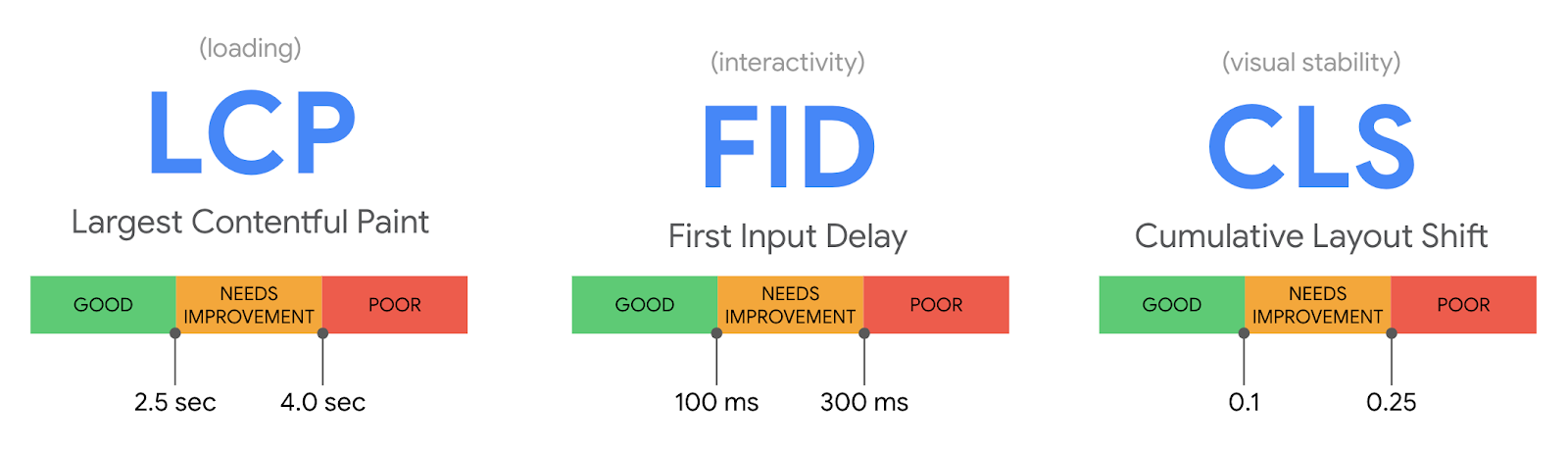
    The metrics in question – three specific page speed and user interaction measurements – are as follows: largest contentful paint, first input delay, and cumulative layout shift.

    It all sounds a bit like digital mumbo jumbo and, as you know, we are anti-mumbo-jumbo here at Numagoo.

    So let’s break it down, in Layman’s terms:

    Google's new Core Web Vitals

    (source: Google Webmaster Blog)

    Largest Contentful Paint – Largest Contentful Paint, or LCP, essentially means ‘loading’ – in this case, how long it takes to fully load the largest content element of the page.

    First Input Delay – The First Input Delay, or FID, metric is a measurement of how soon a user can interact with a site. FID measures the time it takes between a user’s first action on a site (for example, clicking a link) and that action being processed by the browser.

    Cumulative Layout Shift – Finally, the Cumulative Layout Shift (CLS) relates to your site’s visual stability – the extent to which the layout of the page shifts as the page loads.

    You should consider all these things and more when building or updating your site.

    How Do You Keep Track of Your Core Vitals?

    As mentioned, you can do a quick check-up on your Core Vitals using the Google Lighthouse tool or using Page Speed Insight. It is important to note that for most sites there is insufficient field data for these tools to give an accurate reading and we are confident you won’t find a web developer that sets any store by their simulated lab reports. When you have watched a site load with you own eyes in less than two seconds and Page Speed Insights claims that your LCP was 25.4 seconds, you learn a healthy scepticism for Google’s measurement tools.

    In order to make it easy for webmasters to measure the progress of their site toward Core Vital Health, Google have added some helpful reporting. By heading to the ‘enhancements’ section of your Google Search Console account you can view the Core Web Vitals data for your site, measuring performance over time and, hopefully, working toward a better page experience for your users.

    So, Without Great Core Vitals, Its Game Over?  

    Well… no.

    The fact is, there are well over 200 different search engine ranking factors – that we’re aware of. Speed has long been one of them.

    Google’s exact words were: “We will introduce a new signal that combines Core Web Vitals with our existing signals for page experience to provide a holistic picture of the quality of a user’s experience on a web page.” While Google is clear that the ranking signal will be ‘page experience’, and Core Web Vitals will be part of that, page experience also combines mobile-friendliness, safe browsing, HTTPs-Security and Interstitials (popups, for those of us that speak English). So Core Web Vitals is part of a ranking factor which, in turn, is one of hundreds. It might be the centre of the current digital ‘buzz’, most likely due to it being a concrete measure that developers can directly and unambiguously affect, but whether or not it is the place to focus your attention depends very much on how your site performs for the other 199+ ranking factors.

    Google has some of the greatest digital minds in the world. It has financial resources most of us cannot begin to imagine. With all of this at its disposal, and if Core Web Vitals are… well… vital, we figured that Google would have them nailed.

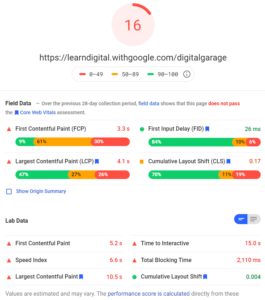
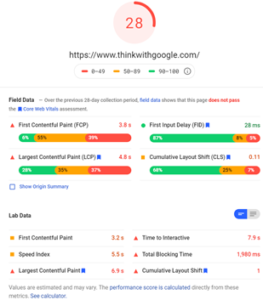
    So, using its own Page Speed Insights tool, we took a look at two of Google’s sites: Learn Digital and Think with Google (below):


    Google Core Web Vitals Digital Garage


    16/100 isn’t the stellar performance score we would have hoped for from one of Google’s own websites, and it only passes one of the three Core Vitals (FID) which is quite disappointing, particularly for a page with very few large assets to be slowing down the Largest Contentful Paint! We initially assumed this was an aberration, but Think With Google wasn’t much more of a success story:


    Google CorGe

    If the team at Google can’t focus on top marks for the search engine’s own sites, it begs the question: how important can Google really think its Core Web Vitals actually are?

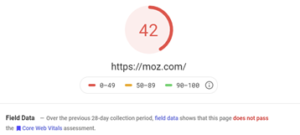
    Expanding our investigations a little further, we took a look at one of the biggest and best-known digital marketing experts in the world: Moz, a site which is always ahead of the curve when it comes to developments in the world of ranking and who have been pretty vocal about the importance of Google’s newest official ranking factor.

    Can Moz meet Google’s expectations on the Core Web Vitals front?


    Moz Core Web Vitals


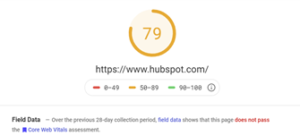
    Yep, you guessed it. For all its articles and recommendations about Core Web Vitals as a ranking factor, Moz doesn’t seem to be giving it a great deal of thought. Since we were on a roll, we also took a look at Hubspot – a Global phenomenon in the digital world and consistently at the top of Google. Unsurprisingly, Hubspot has a considerably better performance score, but even the Hubspot website doesn’t pass the Core Vitals test!


    Hubspot Core Web Vitals

    Do Core Web Vitals Matter Or Not?

    Yes. They matter.

    Core Web Vitals are part of a ranking factor, but it is important to remember that the page experience ranking factor is one of many. And it is arguably not the most important, either.

    Core Web Vitals often don’t reflect the real user experience – websites that appear to load instantaneously can be measured by Google as taking 20+ seconds to fully load – so if you really want to measure your site’s performance,  we believe it’s far more useful to judge your site speed with your own eyes and your user bounce rate. Otherwise, you are relying on a tool that struggles to agree with itself from one audit to the next, as well as reporting data that is out of line with what the user actually experiences.

    SEO is a marathon, not a sprint, and it requires a holistic strategy that considers every touchpoint and all the elements that make a great user experience, from speed performance and layout through to great content, easy to navigate architecture, strong calls to action and pages that match search intent. We would never recommend that a business focuses on only one part of the ranking equation and, if we were to, there are a number of factors that would come well above cumulative layout shift or first input delay.

    Reports and tools are great for a reference point but they have to be taken in context and it takes a full audit to get a true picture of why you might not be performing as well as you would like in Google. If you want some frank, no-obligation advice on how you can improve your search rankings and drive more leads or sales, Get in touch with the Numagoo team for a chat.

  • Why Your Business Needs Digital Marketing

    Why Your Business Needs Digital Marketing

    As a long established Web Design and Digital Marketing Agency, we have been fascinated to watch what can only be described as a digital revolution over recent years. Who would have imagined 20 years ago that shopping, communicating, dating, watching TV and even negotiating business would all be possible via the internet? Here is why your Business needs Digital Marketing.

    In just 20 years digital marketing has transformed our lives massively but brands were not so quick to embrace it. For many years they continued using traditional methods of marketing, buying hugely expensive advertising space and publishing frequent press releases without understanding why they weren’t getting as much “bang for their buck”. Content and Conversations

    The traditional methods of marketing that were so successful in the past are not as powerful. Advertisements placed in newspapers are great assuming people buy and read newspapers. As can be seen from the recent decision The Independent made to stop printing and go digital, fewer people are now buying a hard copy. Many magazines have already made the transition and more will follow in the near future.

    Hard selling has been consigned to history and the word “free” has lost its meaning as customers prefer to communicate, look at reviews and make their decisions to buy online. Google is still the most popular search engine and one that recognised the importance of informative content. Google ranks websites on many factors but one of the most crucial components is fresh content. For example, if you look at two businesses selling exactly the same product or service online, the one that has the best content will be more successful.

    Good content that interests your customers will encourage conversation and that might take the form of an engaging blog and a well-written post on popular social media platforms such as Twitter or Facebook.  Conversing with your customers in a friendly way will achieve far more than straightforward advertising.

    Good Design is Good Business

    At Numagoo we believe a smart slick design is the key to the success of a business. The design of a business is the core of its identity. A good concise design makes the company appear professional to a potential customer. If you think of all the most famous brands and how you as a customer identify them by their logos. Business design is are a central theme to any branding and advertising scheme.

    As a company, you cannot ignore the connection between design and business. A good design allows you to entice customers. We work alongside our customer to create a vibrant design that reflects the ethos of the company. The design for a makeup range would be different to that of a coffee brand. We only create unique designs for our customers. Having a clear consistent brand design across all levels of advertising from work cards, websites to Facebook puts your business a head above the rest.

    Contact us if you would like to improve the design of your business brand.

    Social Media as a Business Tool

    Social media culture and social networking platforms are having a major impact on businesses communication, practices and processes.  They now account for nearly a quarter of the total time spent on the internet. Social media has grown rapidly over the past five years. One example to show this, today nearly 4 in 5 active internet users visit social networks and blogs and close to 40% of social media users access social media content from their mobile phone. When social media is used skilfully by a business it builds an online presence and a community around your brand. It enables you to advertise to potential new customers and give them things to read and get involved in (competitions and debates).What you post on social media is focused on your products and your companies cultures.

    This boom in social media is the prime time to engage with your customers and promote your business. Buyers are absorbing information at a rate faster than ever before. As a business, you need to be aware of this. The winner in all this will be the business who embraces the new models of communication and build a strong healthy productive social communities.

    If you would like to hear more about social media as a business tool contact us via the contact page, or even better, via one of our Social Media channels.

    Online Consistency

    Consistency is an important aspect of any successful business, this includes online consistency. Online business branding starts with the company’s website and continues to other social media, blogs and e-mail marketing. The website should be consistent with the businesses message and target market, this can mean the colour scheme, font and graphics. Additional content and blogs should all link back to the business, this helps build the original brand. With Social media, it is important that there is consistency with posts. There is no point to be inundated with posts one month and then have a stale account the following month. It is much better to organise and schedule your posts with a healthy amount of quality content. This shows potential customers you take care of your social media platforms and are easy to contact. Further to this you need to decide on a brand icon to represent you throughout the internet. You want viewers to be able to connect different online pages with one brand. It also helps your brand to appear professional and streamlined. It goes without saying that all contact information and business details should be the same on all platforms. Online marketing should be consistent in its presentation and message, whether thats on the site, social media or blog. All these factors together create a strong memorable business.

    Unsure if as a business you have the time or knowledge to commit to online consistency, Numagoo is here to help. Contact us for a chat if you want to know more about how to implement a successful Digital Marketing strategy.

  • Ten Reasons Why Website Visitor Tracking Software Can Enhance Your Business Performance

    Ten Reasons Why Website Visitor Tracking Software Can Enhance Your Business Performance

    Ten Reasons

    • B2B Website visitor tracking is becoming increasingly popular for companies looking to add value for sales and marketing in a world where digital marketing and online presence are so vital for success.
    • Many organisations will incorporate Google Analytics and do business with those that get in touch with them directly.
    • But when you consider that around 95% of your daily website visitors will leave your site having not made contact with you, it places you in a restricted position where you have the insight that there are lots of companies exploring your service, but you’ve got no actionable leads to follow-up with.
    • Here are ten reasons why using a platform which can identify the companies coming onto your website and displaying their journey, can enhance your business’ performance going forward.


    1 – Additional leads

    • Most obviously, website visitor tracking software is going to provide you with additional leads which you would never have been able to access otherwise.
    • These leads may be of all different qualities and strengths but it is more opportunities for your sales team members to work with and monitor, which can only be a positive aspect.
    • Coming onto the dashboard every morning and approaching the companies whose metrics appear to be showing lively activity is a simple but extremely effective way to instigate new business.


    2 – Monitor leads in your sales process

    • Alternatively to leads which you would never have had, the leads which you are attempting to progress through your funnel can also be tracked using a website visitor software to identify when they are returning to your site for further inspection.
    • By setting a trigger alert on a specific company, or by adding them to a custom category, you can see exactly when they are visiting, which pages they have looked at and for how long they might have been browsing. This can be for any page such as pricing, billing or particular products/services. Therefore you can instinctively get a feel for when a follow-up might be most appropriate.


    3 – Automation

    • The beauty of website visitor tracking software is that many of the benefits are automated, saving you time to work on separate projects and tasks until the vital moment.
    • All data is real-time and automatically filtered into an organised dashboard, and once you have set up you customised triggers and categories, the system will structure the relevant instructions without your intervention for ultimate convenience.


    4 – Demographical insights

    • The demographical insights from website visitor tracking can be amazingly useful for discovering new markets and areas which you can include in your ideal customer profile or monthly reports.
    • Seeing that you are receiving frequent website visits and interest from a certain country can qualify that it might be worthwhile intensifying your marketing output in that region.


    5 – Learn more about your website performance

    • You will be able to see which pages are getting strong quantities of traffic and those which are not. Therefore you can take the action to improve the visualisation of the underperforming page in order to increase interaction.


    6 – Align your sales and marketing departments

    • Website visitor tracking software can act as a hub for both your sales and marketing departments to feed from and work off. It offers value for each and information can be gathered, discussed and new direction planned from there.


    7 – See your competition movements

    • Website visitor tracking tools will enable you to watch your competition’s movements on your website.
    • This might give you an idea into what they are planning for their next move or it can just be nice to know they are checking you out because you are a threat to them.
    • By setting a trigger to their business, you will see all of their activity going forward on your site and be informed of their instant arrival on any landing page which you choose.


    8 – Enhance your marketing campaign results

    • You can add value to all of your marketing campaigns by putting a business name to the traffic which derives from it. Especially your paid marketing efforts. You are able to collect a genuine contact rather than empty traffic numbers which may or may not convert. You now have the option to follow up or continue to market in their direction.


    9 – Data reporting

    • Having a report of visiting companies available for monthly or weekly reports can be a vital piece of data. And, of course, these can be customised to your exact needs and requirements.
    • A Zapier integration allows you to sync into 100’s of everyday tools meaning your website visitor tracking data is far more conveniently used and adaptable to the way in which you work. Data reporting and sales processing could not be easier.


    10 – Amazing ROI

    • With the price at which is charged for access to website visitor tracking software, when used correctly and efficiently, you will comfortably receive a return on your investment, month after month. Long-term proving to be a worthwhile tool for business success.


    For a 14 Day Free Trial give me a call

    James Devall

    0161 639 0225

    Numagoo

  • RAR Recommended

    RAR Recommended

    RAR Recommended Agency Register

    We’re now how happy to announce that we are a RAR Recommended Agency. You are now able to view our profile, reviews that our past and existing clients have left us for the work that we do. Being alongside over 10,000 other web design agencies, this is a big step for our company and we’re proud to be moving forward with the times.

    How Does It Work?

    RAR is an agency register, where recommended agencies are rated and reviewed. Search a database of over 9000 Agencies from around the world with recent ratings and testimonials from real companies.

    You don’t even need to be a member to search all of the agencies on there. Everything depends on what you’re looking for personally as an individual or as a company. A big company or smaller one, it’s up to you on what relationship you’re looking to build with the agency.

    Being a smaller company ourselves we work hard on our client relationship! As you will get to know the whole team inside out over the time spent. Making us stand out personally to each client individually. Have a look at our profile and leave us some feedback of what you think. RAR is one of a kind, not offering just a website full of web design and development agencies. Going that one step further they provide consultancy, making it even easier for you! They will find agencies best suited for you, saving you the time of scrolling through over 10,000 different ones.

    Numagoo

    Visit our profile.

    Review our case studies, or even visit our newly refurbished website! With everything you need to know about us and what we offer. Also, you can try out our new contact form making it easier for you and us to know what you want quicker than ever. Or if you don’t have to time, give us a call! We’re happy to help with any questions you may have. 0161 639 0225

  • The Simple Reason Why Google Maps Knows When There’s Traffic

    The Simple Reason Why Google Maps Knows When There’s Traffic

    Google Maps tracking data and how it helps us.

    Google Maps is a great asset to everyone in everyday life even if we might not realise it, it gets us out of lost situations and helps us out when we’re in a hurry. You may all have wondered at some point how does Google Maps know if the roads are busy or quiet? Or where does it get its information from?

    Well, the answer is very simple; when we enable our location services on our phones that instantly allows them to send location data back to the servers. The servers are not only getting data from your location but they’re also pulling it from all other pools of data, such as transportation authorities data.

    Obviously, some people may not like the idea of Google knowing exactly where you are, that can be stopped easily by disabling your location services. But why do that? If everyone did that then inevitably Google Maps will crash.